
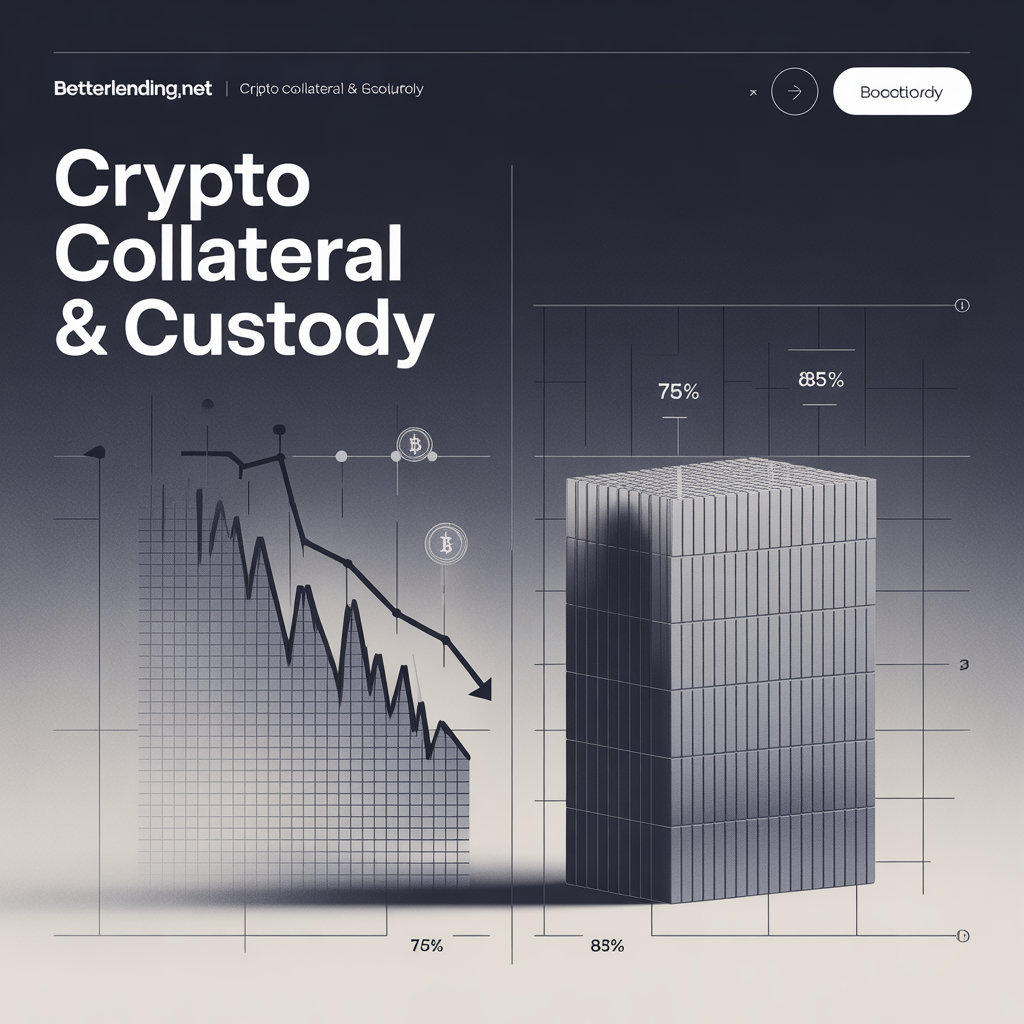
Crypto-backed loans become dangerous above 70% LTV. At 80% LTV, most platforms issue a margin call and above 85–90%, liquidation executes automatically, often without warning. A borrower who enters at 60% LTV with BTC as collateral and then experiences a 35% price drop will see their LTV cross 85%, triggering forced liquidation before they can add capital. This is not an edge case it is the mechanism.Hence why it is necessary to understand crypto collateral &custody
Crypto collateral risk operates across three layers: market risk (price volatility affecting LTV), platform risk (liquidation mechanics and loan structure), and custody risk (who controls and holds the collateral).
A borrower who manages only LTV but ignores custody structure is still exposed to loss even if the loan survives market volatility.

How LTV, Volatility, and Liquidation Actually Work Together
1. The LTV Calculation Is Not Static
Loan-to-value is a live ratio: as the value of the collateral asset falls, LTV rises in real time. A $50,000 BTC loan against $100,000 in BTC starts at 50% LTV. A 30% price drop reduces collateral value to $70,000, pushing LTV to 71.4%. A 45% drop brings collateral to $55,000 LTV hits 90.9%, past the liquidation threshold on virtually every platform.
2. Volatility Compounds the Timeline Risk
Crypto assets can move 20–30% in hours during high-volatility events. This collapses the time window between a margin call and a liquidation event to less than 24 hours. Borrowers who are asleep, offline, or slow to respond do not get a grace period — the liquidation engine does not wait.
3. Margin Call Thresholds Vary by Platform Structure
Most platforms issue a margin call at 75–80% LTV and execute liquidation at 83–90% LTV. The gap between these two levels is the only window available to act: add collateral, repay partial principal, or exit the position entirely. At high entry LTV, this gap compresses to near zero.
Core Risk Framework: Entering, Holding, and Surviving the Position
1. Entry LTV Determines Survival Margin
The entry point is the single most controllable variable in a crypto-backed loan. Entering at 50% LTV against BTC gives a 35–40% buffer before a margin call — historically sufficient to survive most correction cycles. Entering at 70% LTV leaves only a 10–15% buffer. A single bad week eliminates it.
2. Collateral Asset Choice Has Asymmetric Risk
BTC and ETH carry lower platform haircuts and tighter liquidation spreads than altcoins. Many platforms refuse altcoin collateral entirely or apply 40–50% haircuts, effectively raising the functional LTV by 10–15 percentage points before the loan is even issued. Borrowers using ETH as collateral should treat 65% LTV as their practical ceiling, not their starting point.
3. Reserve Liquidity Is Not Optional
Every borrower should hold 10–15% of the loan principal in liquid stablecoin or fiat, ready to deploy as collateral top-up without selling the underlying position. The entire thesis of a crypto-backed loan — preserving exposure while accessing capital — fails the moment the borrower is forced to liquidate assets to cover the loan.
Scenario-Based Thinking: What a 40% Market Drop Actually Does to Your Position
Starting Conditions
- Collateral: 1 BTC, current price $90,000
- Loan amount: $50,000
- Entry LTV: 55.5%
- Platform margin call threshold: 78% LTV
- Platform liquidation threshold: 88% LTV
Phase 1: BTC drops 20% → price = $72,000
- Collateral value: $72,000
- LTV: 69.4%
- Status: Within bounds, no action required — but the buffer has halved
Phase 2: BTC drops 40% → price = $54,000
- Collateral value: $54,000
- LTV: 92.5%
- Status: Liquidation threshold breached — position liquidated, borrower keeps $54,000 – $50,000 – fees = minimal recovery
A 40% correction from $90,000 BTC is not a tail scenario. BTC has experienced nine drawdowns of 30% or more since 2017. Borrowers who treat $50K+ in collateral as permanently stable are mispricing the baseline risk.
The Response Window
At Phase 1 (69.4% LTV), a borrower adding $10,000 in collateral drops LTV to 62%. That buys a 20% additional drop before the next warning. At Phase 2, there is no window — liquidation has already executed.
Decision rule: Set a personal action threshold at 65% LTV — 10–13 points below the margin call — and act there, not at 78%.
Crypto Collateral Custody Framework for Borrowers
Before placing collateral into a crypto-backed loan, borrowers should evaluate four custody variables: control, segregation, rehypothecation, and recovery rights. These determine whether collateral loss can occur outside of market-driven liquidation.
Control refers to who holds the private keys. Segregation determines whether assets are separated from platform funds. Rehypothecation defines whether collateral can be reused, and recovery rights determine what happens if the platform becomes insolvent. Read more; Custodial vs Non-Custodial Crypto Loans in 2026: What Happens When You Deposit Collateral
Borrower Checklist Before Pledging Crypto Collateral
asd Before committing $50,000+ in collateral, confirm the following:
- Entry LTV is below 55% for BTC or ETH
- Margin call and liquidation thresholds are clearly defined
- Collateral is held in segregated custody
- Rehypothecation is either prohibited or clearly disclosed
- Reserve liquidity (10–15%) is available for top-ups
Failure in any one of these areas introduces a risk layer that cannot be corrected after the loan is active.
Platform Comparison: BetterLending vs. Ledn, Nexo, Nebeus, YouHodler
LTV Ranges
BetterLending offers flexible LTV structures with conservative default thresholds designed to preserve borrower positions through volatility cycles. Ledn caps LTV at 50% for BTC-backed loans, which is conservative by design but limits capital access. Nexo allows up to 50–68% LTV depending on collateral tier, with dynamic adjustments based on NEXO token holdings. YouHodler operates at up to 90% LTV, which maximizes capital access but compresses the survival buffer to near zero. Nebeus sits in the 50–68% range with fixed-term options that remove some of the real-time liquidation pressure.
The key difference between platforms is not access to capital, but how many failure modes exist within the loan structure. High-LTV platforms compress the volatility buffer, while rehypothecation introduces a second layer of risk unrelated to market movement.
Borrowers should evaluate platforms based on how many independent risks they are exposed to, not just interest rates or borrowing limits.
Custody and Counterparty Risk
Custody structure determines what happens to collateral if the platform fails — a risk made material by multiple lender collapses in 2022–2023. BetterLending maintains segregated custody arrangements that separate borrower collateral from operational funds. Ledn uses a proof-of-reserves model and partners with Coinbase Custody for institutional-grade storage. Nexo operates in-house custody with insurance coverage, but the policy limits and eligible events are worth reading in full before committing. YouHodler’s custody terms involve exposure to rehypothecation risk, which means the collateral can be lent out — introducing a failure mode entirely separate from price volatility.
Rehypothecation: The Hidden Risk Layer
Rehypothecation — the practice of lending or using pledged collateral for the platform’s own purposes — is the most underappreciated risk in crypto lending. Platforms that rehypothecate collateral expose borrowers to double counterparty risk: the borrower’s own loan position AND whatever the platform has done with the collateral. Before placing $50,000+ in collateral, confirm in writing whether the platform rehypothecates, under what conditions, and how recovery works if the platform becomes insolvent.
Liquidation Structure Differences
Nexo and YouHodler use automated liquidation engines with limited human intervention. BetterLending and Ledn offer more structured margin call processes that include notification windows. The difference is operationally significant: a 6-hour notification window versus an automated liquidation at threshold can determine whether a borrower saves the position.
For borrowers evaluating their collateral strategy further, BetterLending’s guides on choosing loan-to-value ratios for volatile assets and how margin calls are processed in real time provide platform-specific detail on threshold management. The borrower checklist for crypto-backed loan applications covers documentation, custody confirmation, and reserve planning before committing capital.
For more insights chech;
Crypto Loan Liquidation: How It Works and How to Avoid It In 2026
What Is Rehypothecation? Betterlendingnet exposes Hidden Collateral Risk Most Crypto Borrowers Never See
Institutional-Grade Crypto Custody: What Retail Borrowers Can Learn in 2026
Key Strategic Takeaway
The failure mode in crypto lending is not the market drop — it is the entry decision that left no margin to survive it. Borrowers who enter at 50–55% LTV with BTC or ETH collateral, hold 10–15% of loan value in liquid reserves, and set a personal action threshold 10+ points below the margin call level will outlast the majority of correction cycles. Borrowers who enter at 70%+ LTV during a bull run, without reserve liquidity, are not managing risk — they are deferring the liquidation event.
A crypto loan can fail in two ways: through market liquidation or through custody failure. Managing only one of these risks is incomplete.
The objective is to structure the loan so that both LTV thresholds and custody conditions are controlled before entering the position.

Ready to Assess Your Loan Structure?
BetterLendingnet’s team works with crypto holders to structure loans with appropriate LTV, custody transparency, and reserve planning built in. Review current loan terms and start an application — or speak directly with a lending specialist to model your specific collateral scenario before committing.
Frequently Asked Questions
What LTV is considered safe for a crypto-backed loan?
For BTC or ETH collateral, 50–55% LTV provides enough buffer to survive a 30–35% market correction before a margin call is triggered. LTV above 65% compresses the survival window significantly. On platforms with an 80% margin call threshold and 88% liquidation threshold, entering at 65% leaves only a 15-point gap — equivalent to roughly a 17% further price decline at entry.
What happens if the platform liquidates my collateral?
Liquidation means the platform sells enough collateral to bring the loan back to target LTV, or closes the position entirely. In a fast-moving market, liquidation can occur at a worse price than the margin call threshold because execution is not instantaneous. The borrower receives any remaining collateral value after the loan principal, interest, and liquidation fees are deducted — which in extreme cases can be near zero.
What is rehypothecation and why does it matter?
Rehypothecation is when a platform reuses pledged collateral for its own purposes — lending it to a third party, using it as margin on another trade, or posting it as security elsewhere. If the platform becomes insolvent while collateral is rehypothecated, the borrower becomes an unsecured creditor in bankruptcy proceedings, not a secured one. This is how multiple lenders left customers with unrecoverable collateral losses in 2022. Always confirm whether a platform rehypothecates collateral before committing assets.
How do margin calls work in practice?
A margin call is a notification that LTV has crossed a warning threshold — typically 75–80% — and that action is required. The borrower can respond by adding collateral to lower LTV, repaying partial principal, or closing the loan. The window to act varies: some platforms provide 24–72 hours, others have automated systems that proceed to liquidation within hours. Knowing the specific timeline before entering the loan is not optional risk management — it is baseline due diligence.
Can ETH be used as collateral with the same LTV terms as BTC?
Most platforms apply equivalent or slightly stricter terms to ETH versus BTC due to higher historical volatility and different liquidity profiles. Some platforms apply a haircut to ETH collateral, reducing the effective LTV ceiling by 5–10 percentage points. Borrowers using ETH should model their position using a 60% ceiling even if the platform nominally allows 70%, to account for faster collateral value erosion during ETH-specific drawdowns.Share
What is custody risk in crypto-backed loans?
Custody risk refers to the possibility that collateral is lost due to platform failure, mismanagement, or rehypothecation, rather than price movement. Even if a loan avoids liquidation, poor custody structure can still result in loss of assets.
Can a crypto loan fail even if LTV stays safe?
Yes. A loan can remain below liquidation thresholds but still fail if the platform becomes insolvent and collateral is not segregated or is rehypothecated. This is why custody structure must be evaluated alongside LTV risk.
